When you click on links to various merchants on this site and make a purchase, this can result in this site earning a commission. Affiliate programs and affiliations include, but are not limited to, the eBay Partner Network.
Cold War History - Corona Spy Satellite Program of US Air Force & CIA Space NASA
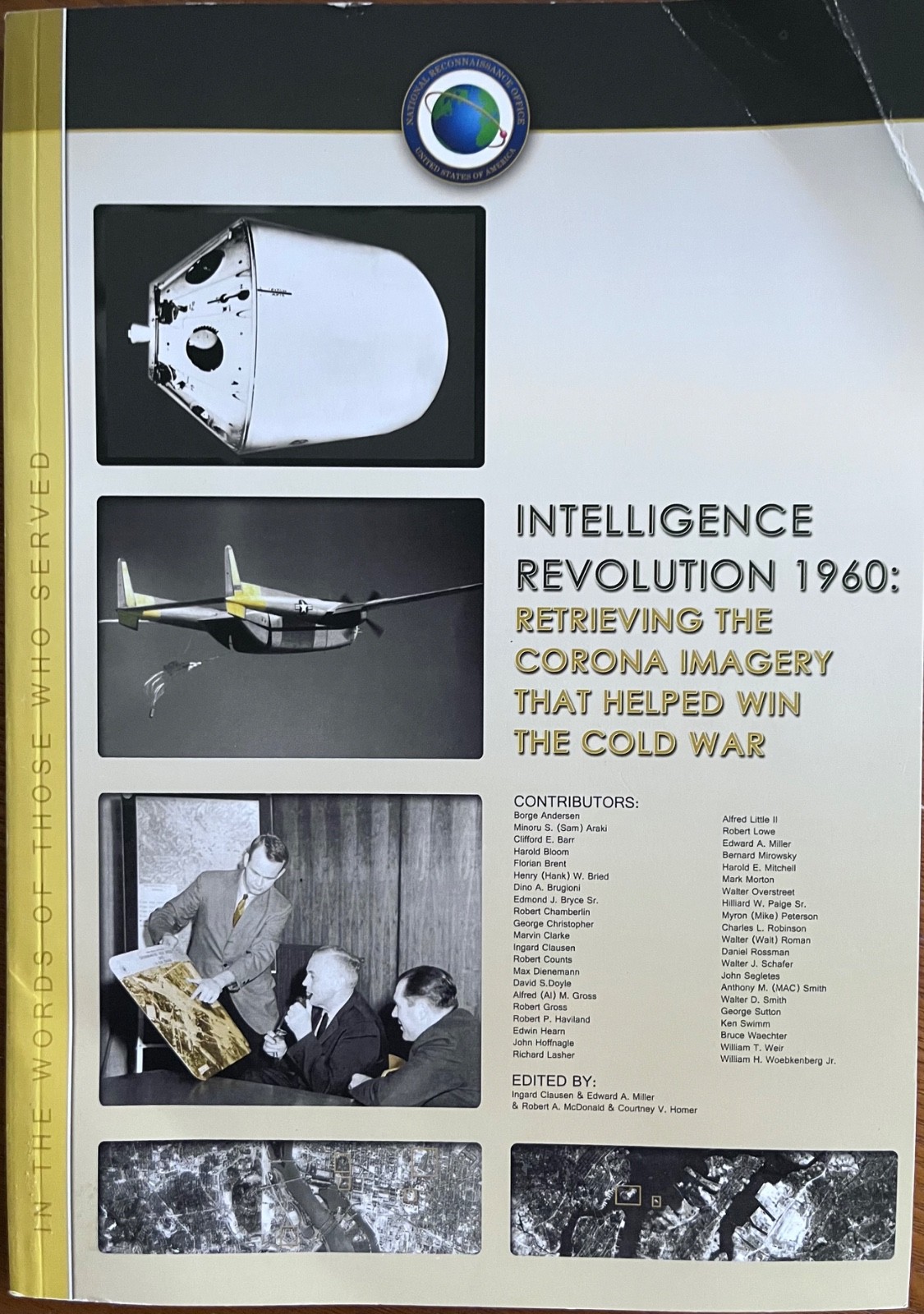
Intelligence Revolution 1960: Retrieving the Corona Imagery That Helped Win the Cold War — Edited by Ingard Clausen, Edward A. Miller, Robert A. McDonald, and Courtney V. Homer
An illustrated, firsthand history of CORONA, the pioneering American spy-satellite program that transformed intelligence gathering during the Cold War. Published in the National Reconnaissance Office’s “In the Words of Those Who Served” series, this volume brings together recollections from more than fifty contributors involved in the engineering, operation, recovery, and analysis of satellite reconnaissance imagery.
Developed jointly by the Central Intelligence Agency (CIA) and U.S. Air Force, CORONA used orbiting cameras to photograph the Soviet Union and other restricted territories. Exposed film was returned to Earth in capsules that descended by parachute and were intercepted in midair by specially equipped aircraft over the Pacific near Hawaii. The photographs were processed by Kodak and U.S. Air Force facilities and analyzed by the CIA’s National Photographic Interpretation Center. CORONA’s first successful mission took place on August 18, 1960.
The book explores the Thor booster, Agena spacecraft, KH-series cameras, satellite recovery vehicles, and the Discoverer cover program. Contributors recount the difficulties of launching satellites, stabilizing and returning capsules, retrieving them by aircraft, and interpreting the resulting photographs. Chapters address the Discoverer II capsule lost near Spitsbergen, the first successful recoveries from orbit, and operational challenges from 1960 to 1973, including a chapter titled “104 Successful Missions.”
Among the contributors are Ingard Clausen, Minoru “Sam” Araki, Edward A. Miller, Dino A. Brugioni, David S. Doyle, Marvin Clarke, George Christopher, Robert Chamberlin, Walter Schafer, Robert Haviland, and Ken Swimm. The volume also discusses Lockheed, General Electric, the National Academy of Engineering’s Charles Stark Draper Prize, and CORONA’s influence on the later GAMBIT and HEXAGON reconnaissance satellite programs.
Beyond the technical history, the book places CORONA within the nuclear arms race and the debate over the perceived U.S.–Soviet “missile gap.” Its imagery helped American analysts assess Soviet missile capabilities and monitor developments such as Soviet intercontinental ballistic missiles and a Chinese nuclear test site near Lop Nor. The program remained classified for decades; its declassification in 1995 allowed many participants to receive public recognition for their work.
Includes historical photographs, personal recollections, an afterword, autobiographical reflections, biographical tributes, a glossary, and an index. Of particular interest to collectors and researchers of Cold War intelligence, the CIA, the National Reconnaissance Office, military aviation, aerospace engineering, satellite photography, and the history of the space race.
Publishing information: National Reconnaissance Office, Center for the Study of National Reconnaissance (CSNR), “In the Words of Those Who Served” series. Illustrated softcover; index begins on page 237. Publication date and ISBN are not visible in the supplied images. The cover shows creasing and surface wear, particularly near the upper-right corner.