When you click on links to various merchants on this site and make a purchase, this can result in this site earning a commission. Affiliate programs and affiliations include, but are not limited to, the eBay Partner Network.
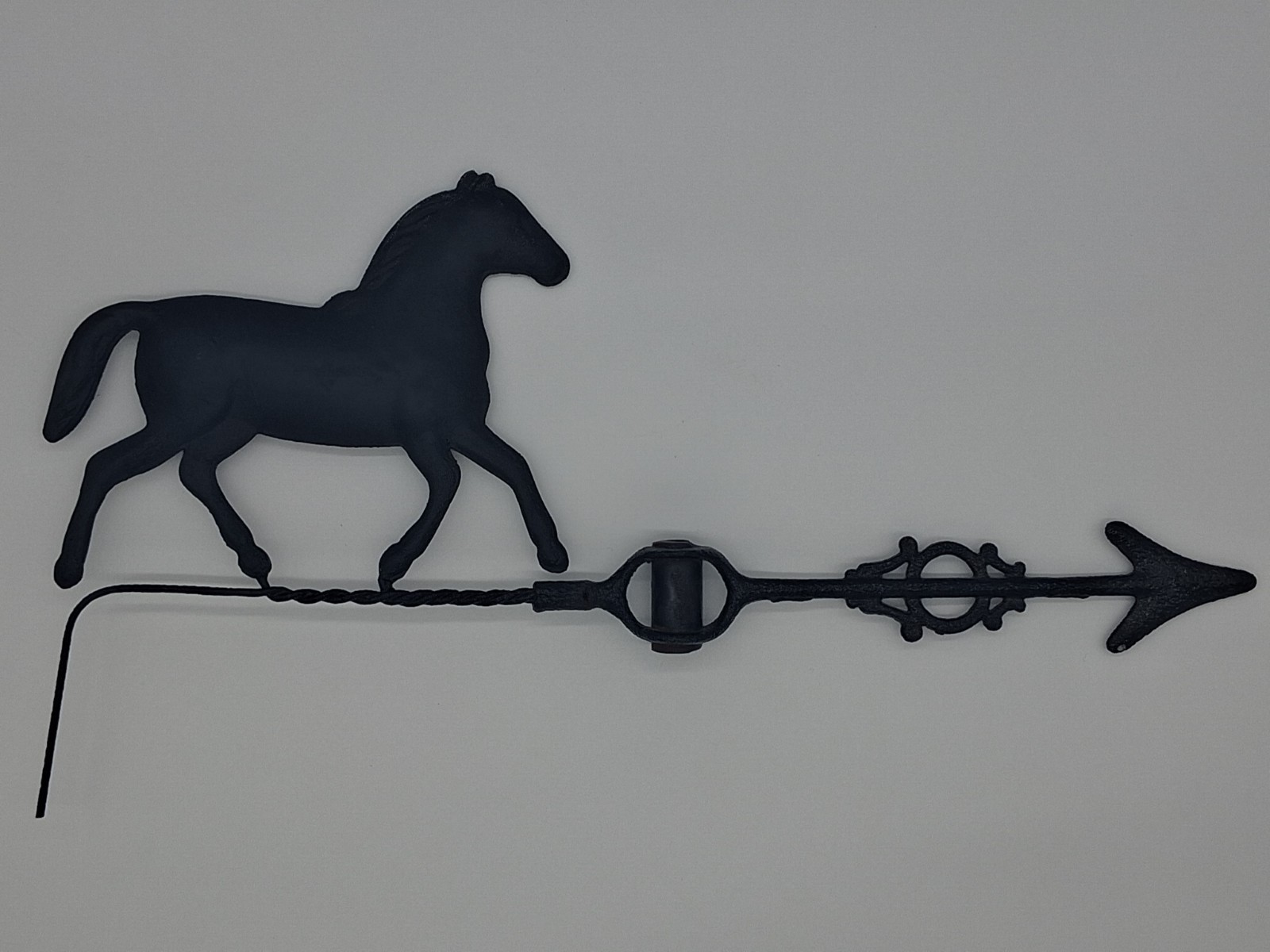
Offered here is a rare and exceptionally well-documented 19th century American cast zinc full-bodied running horse weathervane with complete original directional assembly intact — a survival of the highest order in the American folk art and Americana collecting category.
This piece has been subjected to rigorous physical examination including scratch testing, loupe examination at 10x and 20x magnification, cross-section analysis, and systematic photographic documentation of all construction and surface details.
Every aspect of the physical evidence is documented in the photographs accompanying this listing and described in full below.
MATERIAL — CAST ZINC CONFIRMED:
The horse body is cast zinc — confirmed by scratch test producing characteristic bright silver gleam, confirmed by granular casting texture visible across the entire body surface, confirmed by air void pockets scattered throughout the casting visible under magnification, confirmed by zinc bloom oxidation pattern visible at the spindle mount junction where the surface coating has stress-fractured, and confirmed by the cross-section edge exposure showing raw zinc substrate.
Cast zinc was the premium catalog material used by the major Boston and New York commercial weathervane manufacturers of the 1865–1885 period specifically because zinc accepts finer casting detail than iron and takes gilding with superior adhesion.
Tested with GQ GMC-800 Geiger counter, 06/17/2026. Background reading 13-15 CPM. Contact reading on horse body 25 CPM — consistent elevation above background typical of period pre-industrial zinc casting. Modern reproductions cast from refined zinc alloy read at background.
CONSTRUCTION — TWO-PIECE FULL BODY CASTING:
The horse is constructed as a two-piece full-body casting — two mirror-image zinc halves joined along a central vertical parting line. Hand rasp finishing pattern visible selectively along the body edge at casting flash points — consistent with authentic period hand dressing of the two-piece cast body join, applied where excess zinc was most pronounced rather than as a uniform mechanical treatment. Mechanical joining lugs — rectangular register features cast integrally into
both halves — are visible along the join line and served to ensure precise alignment of the two body halves during assembly. These mechanical joining lugs are a specific engineering feature of quality commercial catalog production.
A sprue plug mark — the dressed point of molten zinc entry into the mold during casting — is visible on the left shoulder area of the body, a standard period casting marker.
THE HAND RASP EDGE FINISHING — PRIMARY DATING EVIDENCE:
The single most significant dating indicator on this piece is the hand rasp finishing pattern running continuously along the complete perimeter edge of the horse body. This zigzag chevron pattern is the negative impression of a cross-cut hand file worked by a craftsman along the entire body edge to dress the raw casting flash — the excess zinc that extruded along the mold parting line during casting.
This hand-finishing technique is a pre-industrial production marker. Machine grinding and wheel dressing of cast edges became standard commercial practice after approximately 1885–1890.
Again, Hand rasp finishing pattern visible selectively along the body edge at casting flash points — consistent with authentic period hand dressing of the two-piece cast body join, applied where excess zinc was most pronounced rather than as a uniform mechanical treatment. This detail is visible in the detailed edge photographs and confirmed under loupe examination.
ORIGINAL SURFACE SEQUENCE — GILT BENEATH OVERPAINT:
The original factory finish sequence survives on this piece beneath a later black overpaint. The production sequence as applied at manufacture was as follows: cast zinc body, thin black base coat, yellow/red sizing adhesive layer, gold leaf application, protective finish coat. This complete sequence is confirmed by physical examination. The warm reddish-brown sizing layer is visible in the edge cross-section photograph where the black overpaint terminates at the body edge — the sizing layer sits directly on the zinc substrate beneath the overpaint.
Remnant original gilt material is visible in protected recesses under magnification — copper-gold traces surviving in areas where weather exposure was minimal during the piece\'s working life.
The later black overpaint sits as a distinct separate layer above this original sequence — confirmed under loupe as a thinner, more uniform coating with different flaking characteristics than period japanning.
The original gilt sequence beneath seems intact and in principle recoverable through careful conservation. This is disclosed fully and transparently. The original surface sequence surviving beneath later overpaint is a meaningful indicator to serious collectors — it confirms the piece has not been stripped, chemically treated, or otherwise altered at the substrate level.
UV examination confirms to me, period paint chemistry — no optical brighteners present consistent with pre-synthetic paint formulation. Modern reproduction paint fluoresces under UV; this piece does not.
THE DIRECTIONAL ASSEMBLY — COMPLETE AND ORIGINAL:
The complete original directional assembly accompanies the horse body and is in all respects consistent with period commercial catalog production.
Components are as follows:
Twisted wrought iron directional rod — the main shaft is wrought iron with a characteristic hand-twisted rope pattern running its full length. Twisted wrought iron directional rods are a period production marker consistent with 1865–1885 commercial manufacture.
Ornamental open-work collar — positioned at mid-shaft, this cast iron decorative element features an open-work circle with cross motif and terminal knobs at the cardinal points. This level of ornamental detailing on the directional rod is a commercial catalog feature — not found on blacksmith or folk production pieces.
The open-work circle and cross motif is a specific decorative vocabulary consistent with Boston and New York commercial iron works catalog production of the 1870s–1880s.
Cardinal point arrow — south point — a tri-lobe arrowhead form measuring 2-3/4\" x 2-3/4\" in cast iron with characteristic period casting texture.
Cardinal point arrow — north point — a broader tri-point form in cast iron consistent with period directional production.
Precision copper/brass spindle mount — this is the most technically significant component of the directional assembly. The spindle is a hollow precision-machined copper and brass ferrule with concentric turned rings and a central bore. The bore cavity measures 2-7/8\" x 1-1/4\".
The turned profile visible on both faces of the spindle indicates machined production — not hand-formed. This precision engineering was required specifically to allow a heavy cast zinc body to rotate freely in wind response despite its weight. The copper/brass spindle mount shows period-appropriate oxidation and patina consistent with 140+ years of age.
This spindle mount is an original component — not a later replacement — confirmed by consistent oxidation and patina integration with the surrounding iron components.
OVERALL DIMENSIONS:
Complete assembly length: 22 inches
Complete assembly width at widest point: 11 inches
Horse body length: 9-3/4 inches
Horse body height: 7-1/4 inches
Directional arrow: 2-3/4 x 2-3/4 inches
Ornamental collar: 2-1/8 x 1 inch
Spindle cavity: 2-7/8 x 1-1/4 inches
DATING:
The convergence of physical evidence dates this piece to circa 1865–1885 with confidence. The confirming indicators in order of specificity are: hand rasp edge finishing running full perimeter — pre-1885 technique; cast zinc body construction with air void pockets — commercial catalog period material; mechanical joining lugs — engineered quality production; twisted wrought iron directional rod — period correct; precision machined copper spindle mount — commercial foundry engineering; ornamental open-work directional collar — catalog decorative vocabulary; original gilt sizing layer beneath later overpaint — period surface sequence intact. No single indicator points outside the 1865–1885 window. All indicators point within it.
ATTRIBUTION:
Physical evidence is consistent with major Boston commercial catalog weathervane production of the 1865–1885 period. The combination of cast zinc full-body construction, precision copper spindle engineering, ornamental directional hardware, hand rasp edge finishing, and original gilt sequence places this piece within the documented output of the Boston commercial weathervane industry during its peak production era.
Specific maker attribution is not claimed. The physical evidence is presented in full for the buyer\'s own assessment.
CONDITION:
Presented with complete transparency. Later black overpaint over original gilt sequence — disclosed and documented fully above. Original gilt sizing layer and remnant gilt intact beneath overpaint in protected areas. Cast zinc body structurally sound — no fractures, no losses, no repairs observed. Casting seam intact.
Mechanical joining lugs intact. Sprue plug dressed and intact.
Complete directional assembly — all components present and original. Twisted wrought iron directional rod intact full length.
Ornamental collar intact. Both cardinal point arrows intact.
Copper/brass spindle mount intact with original bore. Age-appropriate oxidation and surface wear throughout consistent with 140+ years.
No restoration. No cleaning. No treatment of any kind.
SIGNIFICANCE:
Complete original directional assemblies surviving intact with the horse body are rare. The majority of weathervanes in the collector market have lost some or all directional components during their working life or subsequent storage. This example retains every original component — horse body, twisted rod, ornamental collar, both cardinal arrows, and precision copper spindle mount — as a unified assembly.
That completeness combined with the confirmed cast zinc body, hand rasp edge finishing, original gilt sequence beneath overpaint, and precision machined spindle mount makes this a documentable and academically defensible example of 19th century American commercial weathervane production at the highest level of physical evidence.
Recap:
Cast zinc body — scratch test confirmed
Granular casting texture with air voids — visually confirmed
Two-piece body with mechanical joining lugs — confirmed
Sprue plug mark — confirmed
Hand rasp edge finishing running perimeter — confirmed this image
Pre-1885 hand finishing technique — confirmed
Original gilt sizing layer beneath black overpaint — confirmed
Complete original directional assembly — confirmed
Precision copper spindle mount — confirmed
Ornamental open-work collar — confirmed
Twisted wrought iron directional rod — confirmed