When you click on links to various merchants on this site and make a purchase, this can result in this site earning a commission. Affiliate programs and affiliations include, but are not limited to, the eBay Partner Network.
PLANTS THAT EAT INSECTS. DARWIN WANTED TO KNOW HOW.
Picture Charles Darwin leaning over a sundew, watching a tiny insect struggle against its sticky leaves. The plant begins to move. Its glands produce fluid. Slowly, it digests its prey.
This was more than a Victorian curiosity. Darwin saw a scientific question hiding inside something wonderfully strange: How could a plant capture an animal, respond to it, and draw nourishment from it? In Insectivorous Plants, he sets out to find the answer through patient observation and ingenious experiments. The result is one of the most fascinating books by one of science’s most consequential thinkers.
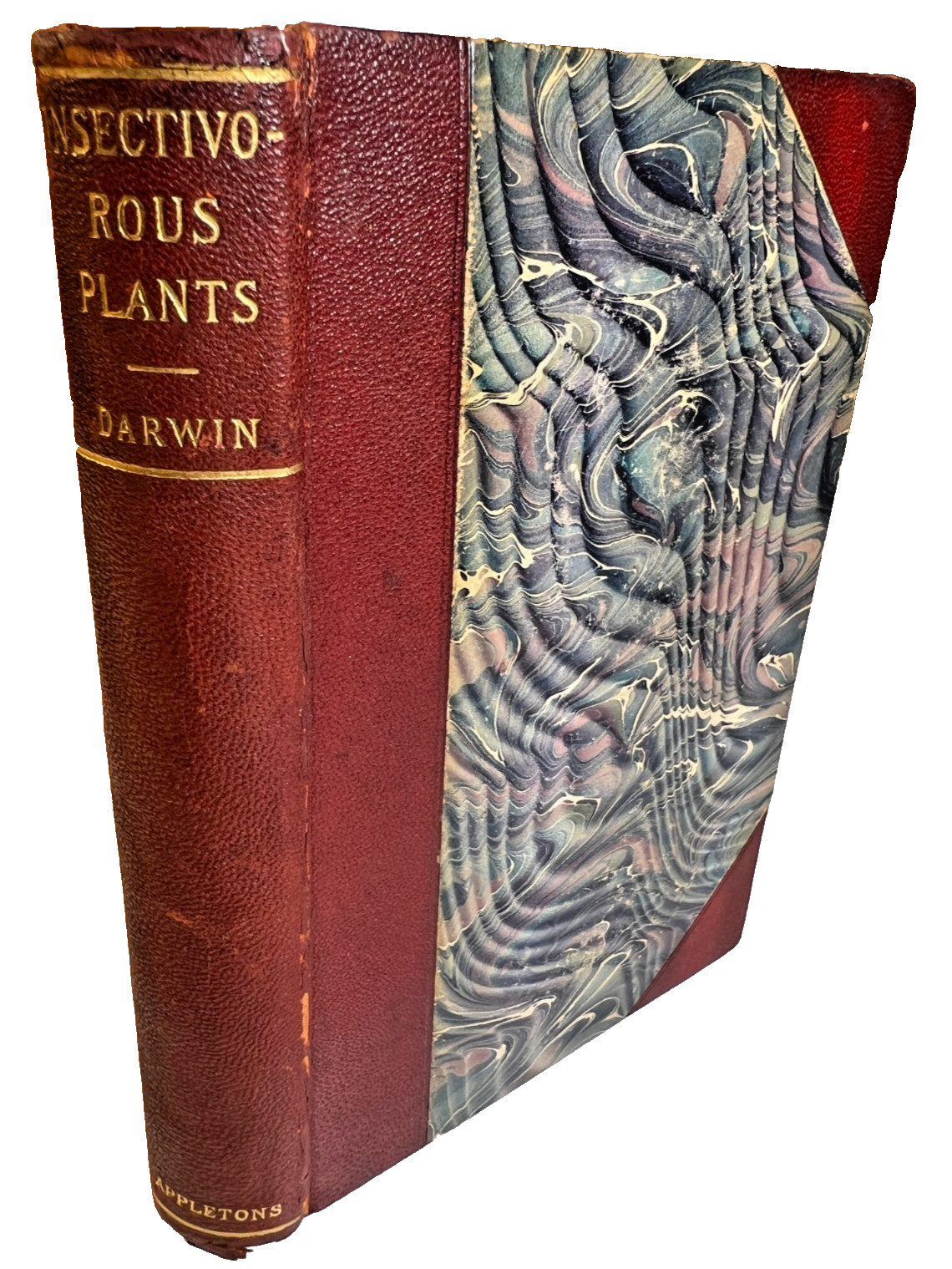
Offered here is an 1896 illustrated “Authorized Edition” of Charles Darwin’s Insectivorous Plants, published in New York by D. Appleton and Company. This is a genuine nineteenth-century printing, beautifully bound in half red leather with richly patterned marbled boards and gilt lettering on the spine.
THE SUBJECT IS IRRESISTIBLE
A Venus flytrap closes around its victim. A sundew holds an insect fast with glistening, sticky tentacles. Other plants use traps and digestive fluids so unlike the familiar image of a passive flower that they seem almost invented for a story.
Darwin takes these extraordinary plants seriously. He examines what causes a trap to respond, how a leaf moves, what its secretions do, and whether the plant actually gains nourishment from what it catches. The pages bring together close observation, carefully designed tests, and illustrations that let the reader follow along. One of the photographed openings features a wonderfully detailed Venus flytrap illustration.
The thrill of this book is watching Darwin investigate a question that still makes people stop in their tracks: Plants eat things? How?
DARWIN’S PLACE IN SCIENCE
Charles Darwin changed how we understand life. His work on evolution and natural selection transformed biology, but his curiosity reached far beyond the ideas for which he is most famous. He studied orchids, earthworms, climbing plants, flowers, animal behavior, and the movements of plants. Again and again, he looked closely at something others had passed by and found a larger story within it.
Insectivorous Plants first appeared in 1875, after years of experiments. Here Darwin applies that searching mind to plants that capture and digest prey. His investigations helped reveal just how active, responsive, and specialized plants can be. More than 150 years after the book’s first publication, its subject remains astonishing.
This 1896 Appleton edition offers that work in an especially handsome late Victorian form. The red leather, swirling marbled boards, and gold spine lettering make it a book to display as well as read—a natural fit for a Darwin collection, a botanical library, or the shelves of someone who has never stopped being amazed by a Venus flytrap.
BOOK DETAILS
Title: Insectivorous Plants
Author: Charles Darwin
Publisher: D. Appleton and Company, New York
Date: 1896
Edition statement: “Authorized Edition”
Binding: Half red leather with marbled boards and gilt spine lettering
Illustrated: Yes, with figures of the plants discussed in the text
CONDITION
A beautiful, visually striking antique copy. The marbled boards retain their dramatic pattern, and the gilt spine title remains clear and attractive. There is age-appropriate rubbing to the leather, with wear at the spine ends and corners. The pages shown are clean and legible, with the warm toning expected of a nineteenth-century book. Please study all photographs for the best account of the binding and condition.
Some old science books merely describe a discovery. This one lets you sit beside Darwin as he asks what happens when a plant catches its dinner—and then works, experiment by experiment, to find out.