When you click on links to various merchants on this site and make a purchase, this can result in this site earning a commission. Affiliate programs and affiliations include, but are not limited to, the eBay Partner Network.
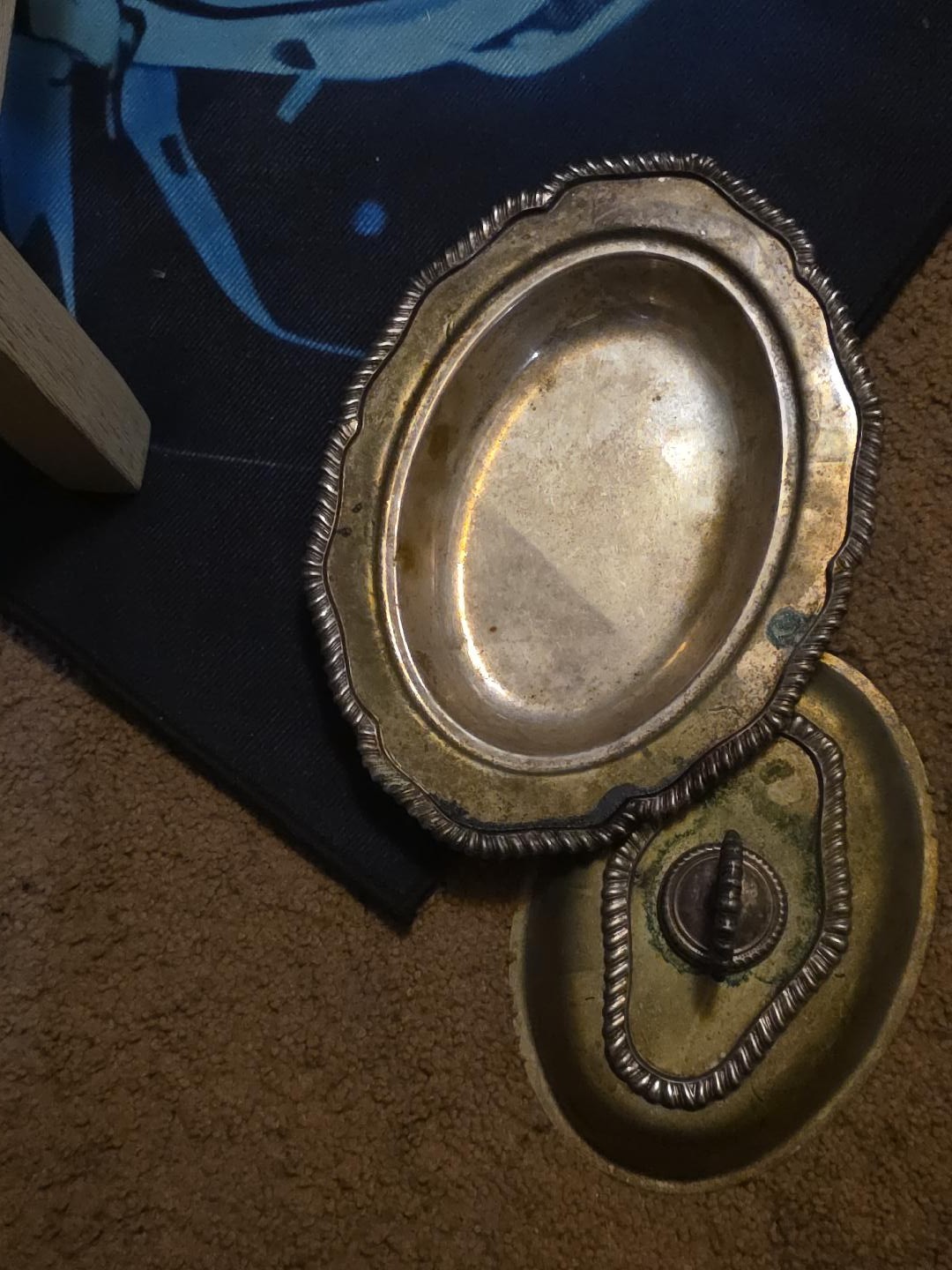
Antique English silver-plated convertible double serving dish / covered entrée dish with an unusual removable handle and reversible two-piece design.This piece has been the subject of considerably more research than a typical silverplate serving dish, including direct correspondence with specialists in England. Based on that research, we believe it is appropriately attributed to Henry Wilkinson & Co. of Sheffield, England, although this is not being offered as a formal appraisal or authentication.The most important identifying feature is the crossed-keys device inside a shield stamped into the piece. After photographs of the mark and dish were sent to specialists, Emma Paragreen of the Sheffield Assay Office identified the crossed-keys trademark with Henry Wilkinson & Co., with the relevant period approximately 1855–1892. This is a manufacturer\'s/trade mark associated with electroplate, rather than a sterling silver assay hallmark.We also received a response from Iona Farrell at the Victoria and Albert Museum (V&A). After reviewing the photographs, she identified the piece as English electroplate and also associated the crossed-keys mark with Henry Wilkinson & Co. The V&A research further confirmed that serving dishes with this type of detachable handle and convertible construction appear in period trade catalogues, although an exact catalogue illustration of this particular model has not yet been located.The construction is one of the features that makes the piece especially interesting. When assembled, it functions as a traditional covered entrée or serving dish. The ring-style handle can be removed, allowing the cover to be inverted and used separately, effectively creating two serving dishes from one piece. This convertible design is much more elaborate than a standard covered vegetable dish.Another intriguing feature is the repeated number “85.” It appears on multiple components of the dish. Specialists have suggested that it may have served as a pattern, factory assembly, or internal production number, but its exact meaning remains unresolved. We are specifically NOT representing “85” as a date.The underside also retains a later label from Universal Electro-Plating Co., Inc. of Washington, D.C. Research into that company indicates that Universal professionally restored and replated silver and silver-plated hollowware. The Universal label therefore appears to document a later professional restoration/replating of this piece rather than its original manufacture. Correspondence and research have also raised the possibility that the replating process may have softened or obscured some shallower original marks.This piece should therefore be understood as electroplated base metal / silverplate, NOT sterling silver.Henry Wilkinson & Co. was an important Sheffield manufacturer, and the company was ultimately liquidated in 1892. Both the Sheffield Assay Office identification and the independent V&A response are significant pieces of supporting evidence for the Wilkinson attribution, though research is continuing in hopes that surviving Sheffield catalogues may eventually identify the exact pattern.We have priced this example somewhat higher than an ordinary unidentified silver-plated serving dish because of the combination of:• The crossed-keys trademark attributed by specialists to Henry Wilkinson & Co., Sheffield
• Independent correspondence with both the Sheffield Assay Office and Victoria and Albert Museum
• The unusual convertible two-dish construction
• Removable ring handle and reversible cover
• The repeated and still-unresolved “85” factory/assembly marking
• Surviving evidence of later professional restoration/replating by Universal Electro-Plating Co.
• The potential for additional identification through surviving Wilkinson trade cataloguesThere is still more to learn about this piece, and we have intentionally kept unresolved details identified as such rather than turning theories into facts.Please review all photographs carefully for condition, construction, marks, surface wear, and details. Antique silverplate should be expected to show evidence of age, use, polishing, and in this case documented later restoration/replating.Offered OBO. Reasonable offers are welcome.