When you click on links to various merchants on this site and make a purchase, this can result in this site earning a commission. Affiliate programs and affiliations include, but are not limited to, the eBay Partner Network.
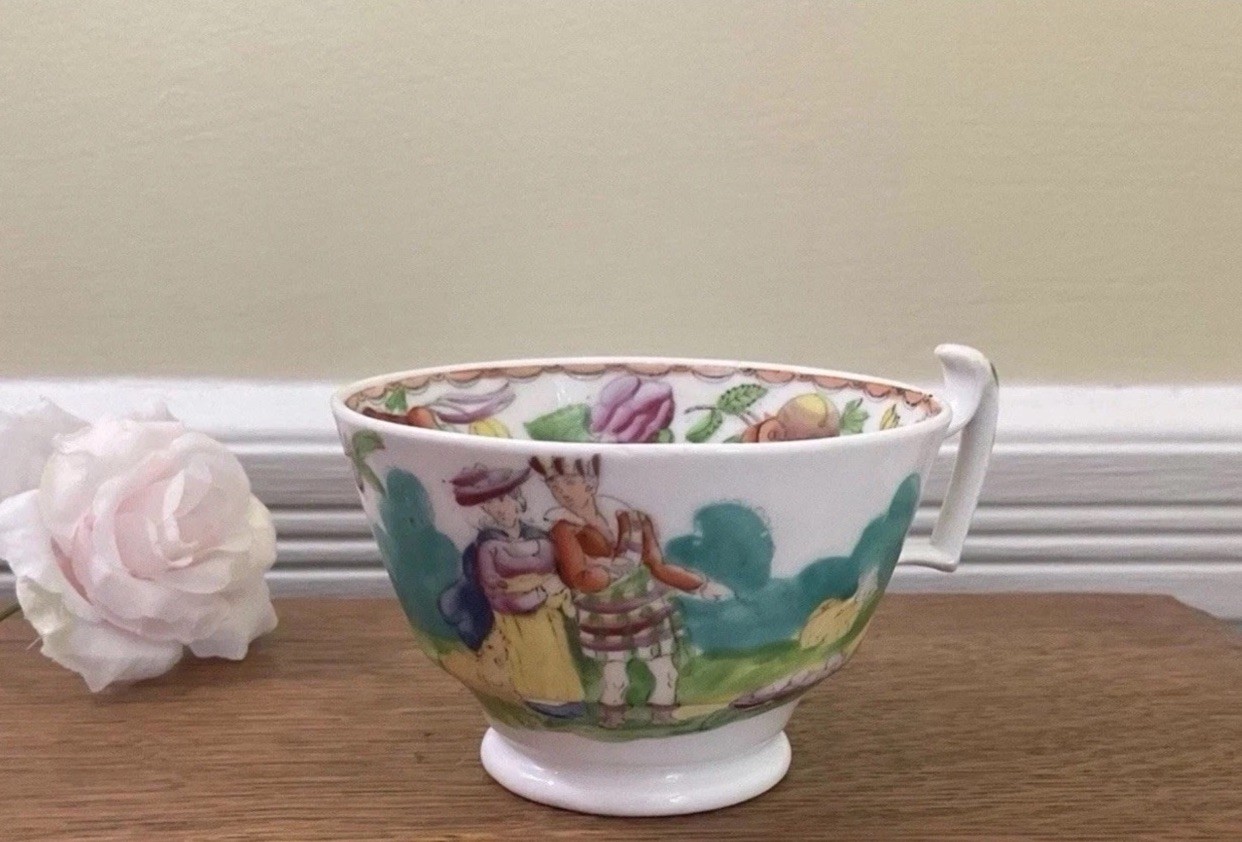
This is for an antique, around 200 years old, white bone china teacup (no saucer) most likely made in Staffordshire England sometime in the early 1800’s based on the characteristics of the cup.
As was common in the late 1700’s and early 1800’s there is no manufacturer mark or pattern number on this piece. The teacup is decorated with both a transfer pattern and handpainted details, which was common then.
This pattern is pretty unusual, showing a Scottish couple, with the man wearing a kilt, and what looks like the backdrop of the Scottish highlands. And there are farm animals, not sure if sheep or cows, in a green pastures. This cup is decorated with a combination of a transfer design that was applied and then details painted in. I can see the brushstrokes in places and feel the raised paint on the man’s kilt. This pattern of a Scottish couple was popular in London high society following a trip by King George IV to Edinburgh Scotland in 1822, which further dates this cup to the 1820’s.
The transfer method of decorating china was invented in the late 1700’s, but handpainting continued a while longer. Applying the design by transfer was not as labor intensive and did not require the skills of an artist, so handpainting became less common. Also from the early 1800’s is the handpainted detail in the bottom of the cup, 3 farm animals in a meadow on this teacup, so that the tea drinker would see and admire it when finished with the tea!
The other thing is the London handle and cup shape, which first appeared around 1812, was extremely popular from 1815 to 1825, and started fading in popularity by around 1830, handle shapes changing shape to ornate flowing and curving handles.
On this cup, you cannot help but notice how white the china is. The history of bone china in England, helps date it also. The English pottery, New Hall had a patent on making hard paste porcelain until 1796 according to the books on New Hall China by David Holgate. Because of that patent, other potteries could not make porcelain. By 1790, Josiah Spode is credited with developing a new formula, by adding bone to a clay mixture, which had several advantages over hard paste porcelain. First, the bone china could be fired at a lower temperature in the kiln, saving fuel with less breakage, meaning it was less expensive to produce. Also the bone china was significantly whiter than New Hall porcelain, which has an off white, even grayish tinge. Bright white bone china was much prettier, especially displaying colorful patterns. Even New Hall switched over to making bone china by around 1812-1814.
This cup is in really excellent around 200 year old condition, with no chips or cracks and little crazing. There is a bit of kiln debris in the glaze on the bottom of the cup, that is not covered entirely by the glaze so it’s a bit rough, and there is another small spot there that the glaze did not cover completely either, that can be felt. There is not much wear to the decoration, but the handle has a bit of discoloration.
The cup is 2 & 1/4 inches tall, not including the handle, 3 & 1/2 inches diameter, holds 2/3 cup, and weighs 4 ounces.
Please zoom in on the pictures and see the 360 degree video for a closer look.
I pack with lots of bubble wrap for safe shipping - with over 1000 fragile china items successfully shipped worldwide with zero breakage! I ship out quickly, within one business day, sometimes same day, and on Saturdays if I can pack it up and get to the Post Office before they close at noon.
I’d love to save you money if you’d like more than one item by COMBINING SHIPPING ☺️, whenever I can. International combined shipping is a bit more complicated so message me about that.
Any questions, please ask and thanks for looking!!