When you click on links to various merchants on this site and make a purchase, this can result in this site earning a commission. Affiliate programs and affiliations include, but are not limited to, the eBay Partner Network.
During the 17th and 18th centuries, theCatholicCounter-Reformation reshaped Europe and expanded into the Americas toevangelize native peoples. Bronze medals were a significant but common object mintedduring this period. Each medal tells a unique story because they are sourced fromCatholic convents, estate collections, and metal detector enthusiasts.
Due to their use, being touched hundreds or thousands of times,and often being carried and worn in harsh environments, the medals will showthe natural surface wear (patina) created by their age, use in devotion, and byexposure to the elements. They are found in modern days both aboveground insometimes buried, as with other artifacts.
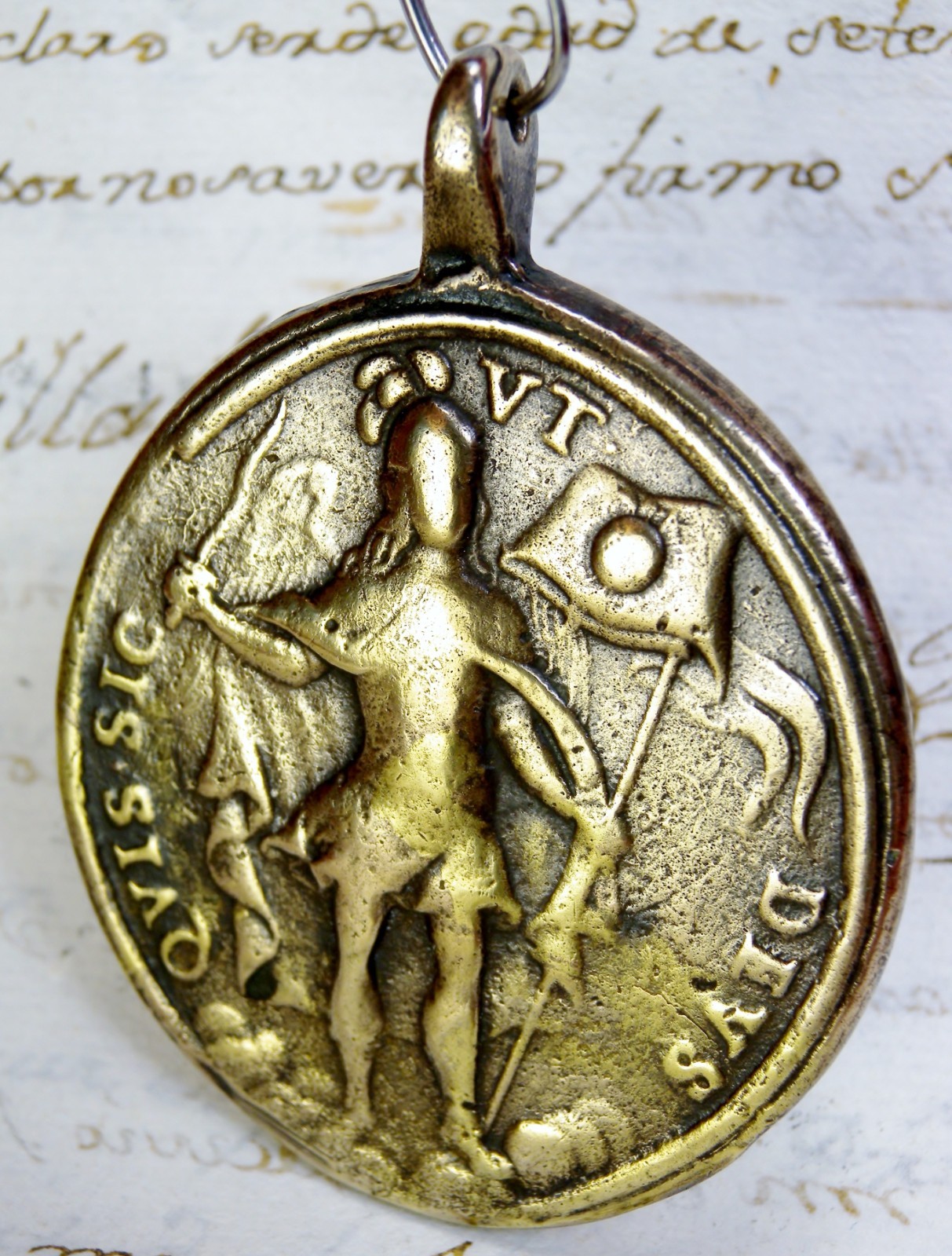
This medal is 2 inches long, weighs 27 grams, and wascast in Rome, as indicated by the hallmark. It dates from the 18thcentury. Itssale will benefit two Carmelite Convents who feed poor kids in SouthAmerica. Its provenance is my mother's estate collection. The informationposted and photographs are from her own inventory notes, and we have no otherinformation available other than her description.
The medal in this listing is the medal that will arrive.Each medal in her collection varies in age, condition, and patina.
HISTORICAL Reference Catholic Holy Trinity: according tothis central mystery of most Christian faiths, there is only one God in threepersons: while distinct from one another in their relations of origin (as theFourth Council of the Lateran declared, "it is the Father who generates,the Son who is begotten, and the Holy Spirit who proceeds"); and in theirrelations with one another, they are stated to be one in all else, co-equal,co-eternal and consubstantial, and each is God, whole and entire. Accordingly,the whole work of creation and grace in Christianity is seen as a singleoperation common to all three divine persons, in which each shows forth what isproper to him in the Trinity, so that all things are "from theFather", "through the Son" and "in the Holy Spirit".
Saint Michael: is an archangel in Judaism, Christianity,and Islam. In Roman Catholic, Eastern Orthodox, Anglican, and Lutherantraditions, he is called "Saint Michael the Archangel" and “SaintMichael". In the Oriental Orthodox and Eastern Orthodox traditions, he iscalled "Taxiarch Archangel Michael" or simply “ArchangelMichael". Michael is mentioned three times in the Book of Daniel. The ideathat Michael was the advocate of the Jews became so prevalent that, despite therabbinical prohibition against appealing to angels as intermediaries betweenGod and his people, Michael came to occupy a certain place in the Jewishliturgy. In the New Testament Michael leads God's armies against Satan's forcesin the Book of Revelation, where during the war in heaven he defeats Satan. Inthe Epistle of Jude Michael is specifically referred to as "the archangelMichael". Christian sanctuaries to Michael appeared in the 4th century,when he was first seen as a healing angel, and then over time as a protectorand the leader of the army of God against the forces of evil. By the 6thcentury, devotion to Archangel Michael is widespread both in the Eastern andWestern Churches. Over time, teachings on Michael began to vary among Christiandenominations.
This medals dating can be confirmed on pages 2 & 3 ofthe book AN INTRODUCTION TO RELIGIOUS MEDALS, by Bob Forrest, and published numismaticINTERNATIONAL in 2004.In addition, this book has chapters (outlined in thetable of contents), describing each of the categories of medals, their possibleplace of pilgrimage (acquisition), and origin of the mint where they were made.We recommend that anyone serious about collecting medals from this periodacquires a copy of this book.
Thanks for your kind support for our work!