When you click on links to various merchants on this site and make a purchase, this can result in this site earning a commission. Affiliate programs and affiliations include, but are not limited to, the eBay Partner Network.
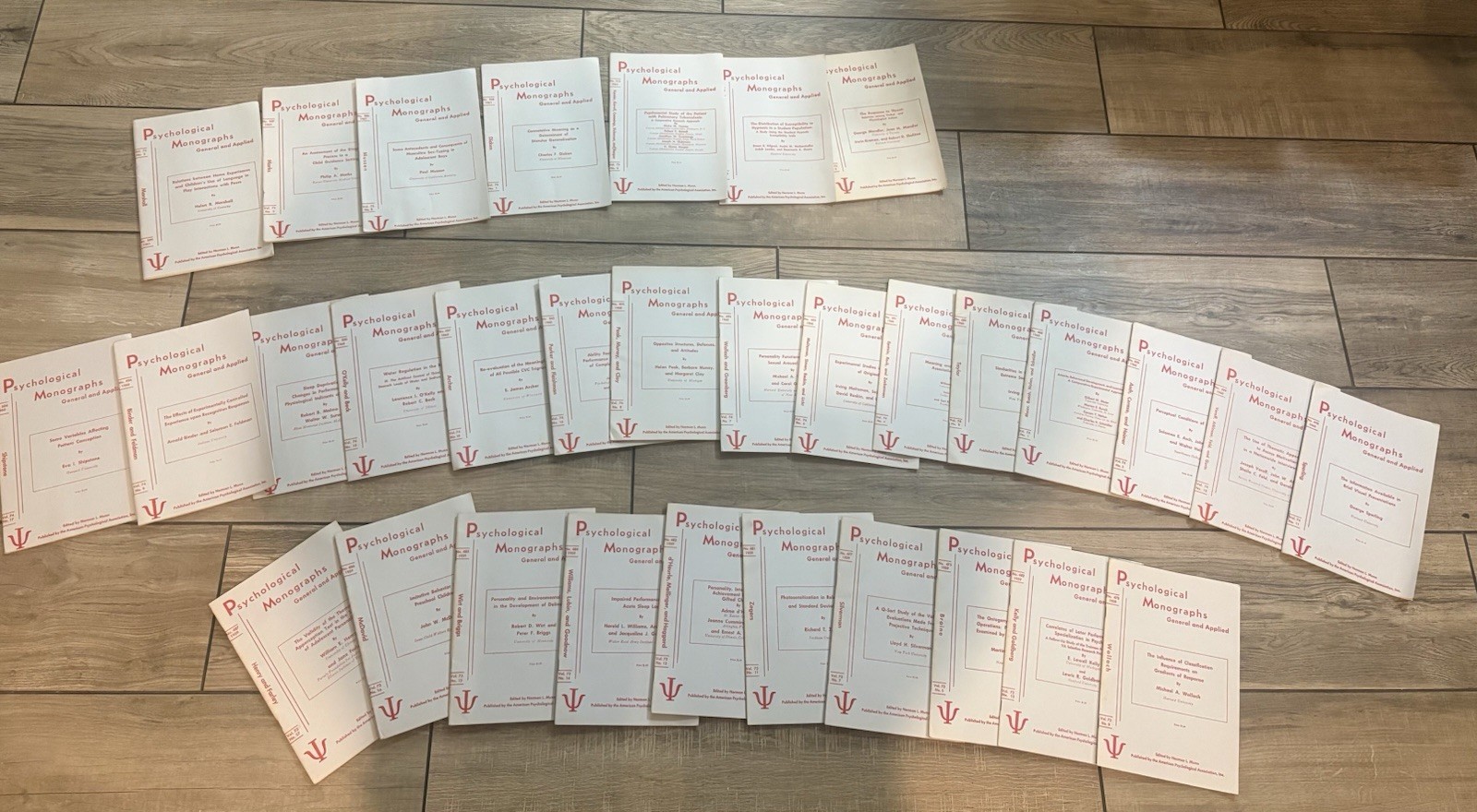
Lot of 32 original vintage Psychological Monographs: General and Applied, published by the American Psychological Association between 1959 and 1961.
The collection contains original mid-century psychological research from scholars associated with Harvard, Stanford, Yale, New York University, University of Michigan and other major institutions.
A particularly notable issue is George Sperling’s 1960 “The Information Available in Brief Visual Presentations,” Vol. 74, No. 11, Whole No. 498. Sperling’s influential experiments became foundational to the study of visual sensory memory, later commonly referred to as iconic memory.
Other researchers represented include George Mandler, Lewis R. Goldberg, Michael Wallach, Robert B. Malmo, Martin D. S. Braine, James E. Archer and numerous others.
Research topics represented include visual memory and perception, sleep deprivation, child development, gifted children, personality assessment, hypnosis and suggestibility, learning and cognition, gender-role development, delinquency, physiological responses and other areas of experimental and applied psychology.
Condition:
Original vintage publications showing age-appropriate wear. Covers generally remain clean and well preserved, with varying degrees of toning, minor edge/corner wear, occasional marks and discoloration. Please examine the photographs carefully for condition.
Interiors have not been inspected page-by-page, so no representation is made regarding annotations or other minor internal condition issues. This is also not represented as a complete consecutive run of Psychological Monographs.
All 32 publications shown are being sold together as one lot.
An unusual collection of original mid-century psychological research particularly suited to collectors of psychology and scientific history, researchers, educators, libraries or anyone interested in the development of modern experimental psychology.