When you click on links to various merchants on this site and make a purchase, this can result in this site earning a commission. Affiliate programs and affiliations include, but are not limited to, the eBay Partner Network.
Narrative of a Journey through the Upper Provinces of India
Heber, Reginald, D.D.
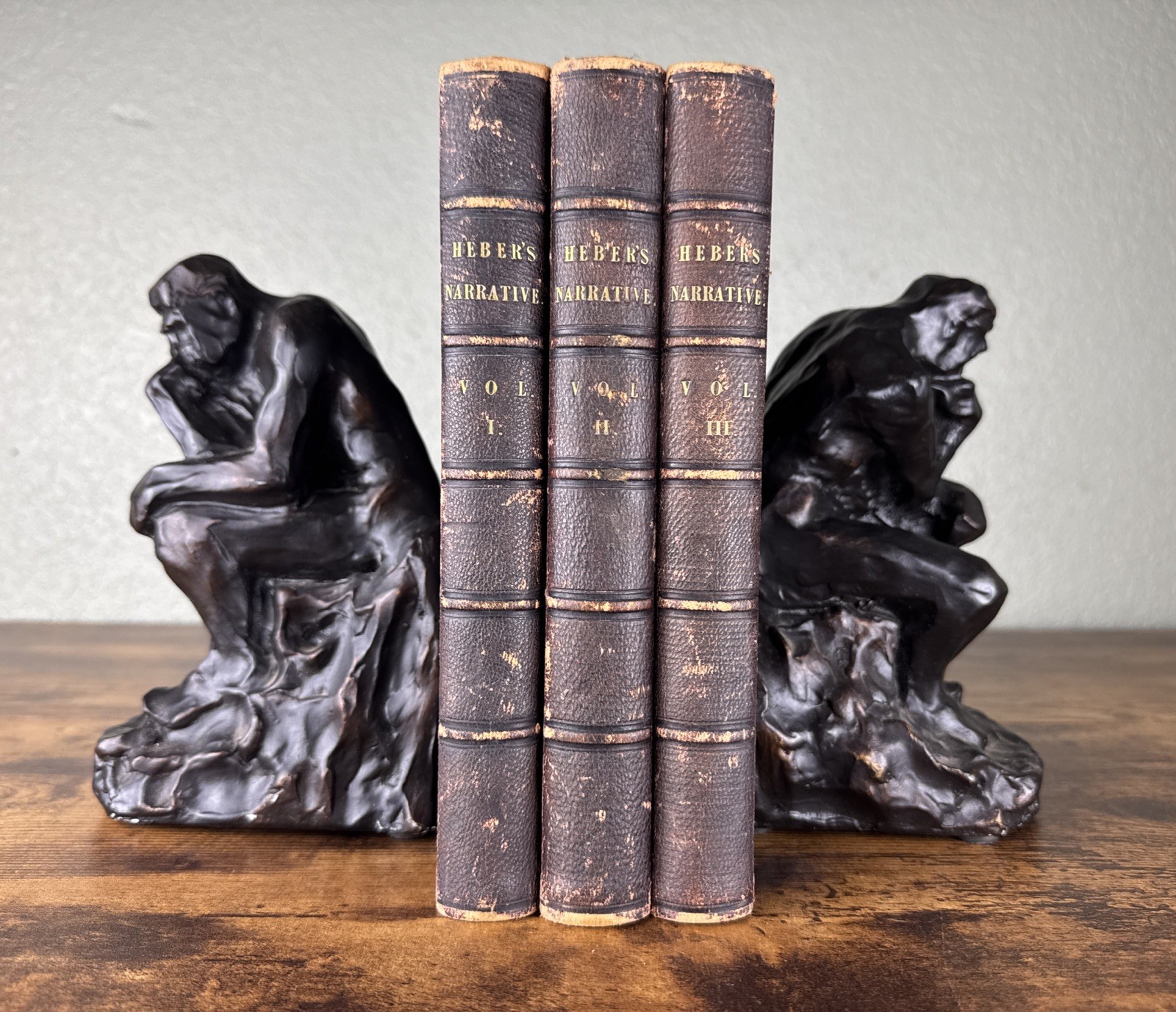
Narrative of a Journey through the Upper Provinces of India, from Calcutta to Bombay, 1824–1825; with Notes upon Ceylon; an Account of a Journey to Madras and the Southern Provinces, 1826; and Letters Written in India.
London: John Murray, Albemarle Street, 1828.
Second Edition. Complete in three volumes.
⸻
Description
Octavo. Contemporary half calf over marbled boards, flat spines gilt ruled and lettered, volumes numbered. Marbled edges and endpapers. Binder’s ticket of Roake & Varty, Booksellers and Bookbinders, 31 Strand, to front pastedown.
Illustrated throughout with numerous engraved plates and vignettes, including scenes of Indian daily life, occupations, river traffic, architecture, and landscape (e.g. Fishermen on the Ganges, Hindoo Cotton Spinners, Indian Peasantry, Imambara and Gate of Constantinople, etc.). Printed by R. Gilbert, St. John’s Square.
⸻
Condition
A sound, attractive, and entirely unrestored period set. Bindings firm, joints intact; spines rubbed and darkened with surface wear and small losses to extremities, commensurate with age. Boards scuffed. Internally clean and bright overall, with occasional light foxing and offsetting. One early ink ownership inscription to a blank (non-obtrusive). Plates crisp and well-impressed. No repairs, no rebacking.
Overall Good to Very Good for an early 19th-century travel work in original-style binding.
⸻
Notes
Reginald Heber (1783–1826), later Bishop of Calcutta, offers one of the most important early English clerical and cultural accounts of British India. His narrative combines travel, ethnography, religious observation, and political commentary, and was widely read on publication. The John Murray editions are especially sought after for their quality of production and illustrations.
This copy is enhanced by its near-contemporary London binding, executed by a named Strand binder — a desirable feature for collectors who value period integrity over later rebinding.